Equity volatility
BABA Is Priced as Commerce. Its Long-Dated Options Ignore the AI Rewrite.
Alibaba's commerce engine funds Cloud, Qwen, and T-Head. The stock carries a China discount; long-dated options barely price the chance that the company changes category.
Alibaba is a Chinese commerce cash machine financing a cloud-and-AI stack. The stock prices the cash machine. The long-dated options barely price the chance that the rest changes what the company is.
For an American reader, Alibaba starts with two apps. Taobao is the open bazaar: a vast assortment sold by merchants and individuals. Tmall is the mall: official storefronts for domestic and international brands. Sellers own most of the inventory. Alibaba sells attention, placement, transaction services, and fulfillment.
That commerce engine sits beside a much larger collection. Ele.me delivery, Fliggy travel, and Amap serve Chinese consumers. AliExpress, Lazada, Trendyol, and Alibaba.com make up most of its international commerce business.
Then there is Cainiao logistics, Freshippo, Alibaba Health, and DingTalk. Cloud, Qwen, and T-Head form the technology stack at the center of this article.
On paper, the collection resembles Amazon's commerce-and-cloud machine crossed with Alphabet's ads, models, and custom silicon. The public-market record is the opposite.
Same ingredients, completely different outcome
Measured from Alibaba's first full month as a public company in September 2014 through August 17, 2026, the same window for all three stocks, BABA returned 49%, Amazon returned 1,516%, and Alphabet returned 1,079%. The chart's dashed lines mark OpenAI's 2015 launch and the 2017 Transformer paper. The U.S. hyperscalers rode the infrastructure trade; Alibaba spent most of the period below its 2020 peak.
The article's thesis is narrower than “BABA should trade like GOOGL.” China explains a stock discount. It does not explain why BABA's long-dated options trade near realized volatility while Cloud, Qwen, and T-Head are trying to change the market's classification of the company.
What Alibaba is
The closest U.S. shorthand for Taobao and Tmall is Amazon Marketplace with a Google Ads auction laid over it. Merchants bring the products and most of the markdown risk; Alibaba charges for discovery, advertising, commissions, and services. This marketplace, not Cloud, still pays for the group.
One marketplace pays for everything else
Buy goods, store them, mark them up, and absorb what does not sell. That is Amazon's first-party retail business.
Merchants bring the products and risk. Alibaba sells them consumer attention and takes a cut of the transaction.
Millions of sellers list goods on Taobao and Tmall. They own the stock and carry most markdown risk.
Merchants bid for placement, traffic, and conversion. This is closer to Google Ads than Walmart.
Advertising, commissions, delivery, and service fees turn someone else's inventory into Alibaba revenue.
China e-commerce produced $17.72B of quarterly revenue and $3.48B of adjusted EBITA. Cloud added $550M. International commerce was roughly break-even. “All others” lost $3.07B as Alibaba funded technology, quick commerce, and consumer AI.
Adjusted EBITA is not cash flow, and segment revenue includes eliminations. The direction is still plain: the marketplace produced the profit; Cloud contributed a little; the rest spent most of it.
What Alibaba is building with the cash
The stack has three parts. Cloud sells the compute. Qwen creates demand for it. T-Head lowers the cost and reduces dependence on foreign chips.
Usage, Cloud invoices, and T-Head compute
A family of Alibaba-built language, vision, and reasoning models. Some weights can be downloaded; larger managed versions are sold as APIs.
The metered enterprise layer: hosted models, compute, storage, databases, networking, and security.
Alibaba-designed processors for training and running AI models. Alibaba reported more than 100,000 units deployed on its public cloud by March 2026.
Qwen works like GPT or Gemini as a brand: it names a family of models, not one chatbot. Alibaba trains the family, runs consumer products on it, releases downloadable weights, and sells managed access through Cloud.
DeepSeek is not part of Alibaba. Alibaba publicly denied the rumored investment. Hosting a DeepSeek model creates Cloud revenue; using Qwen also gives Alibaba the model economics.
Qwen against the current model field
The general engine behind chat, coding, search, and enterprise agents.
Several sizes and products sharing a name, from cheap local models to hosted flagships.
Developers can download the trained parameters and run them away from the maker's cloud.
The repeated compute used every time a trained model answers a request.
On the August 2026 Artificial Analysis leaderboard, Qwen3.7 Max trails the highest-scoring Claude and OpenAI configurations while sitting near the tested Google and DeepSeek flagships. Click View more for cost, speed, and latency. The commercial question is whether developers and Chinese enterprises run useful workloads through Alibaba's meter, not whether Qwen wins every benchmark.
Open weights help Qwen travel. Developers can download variants and run them without an Alibaba account. When a company wants managed hosting, security, databases, or support, Alibaba Model Studio sends the bill.
Every request consumes inference. T-Head designs the Zhenwu processors that run some of it. The deployment figure comes from Alibaba; it is not an independent chip benchmark.
Cloud rents the compute. SanDisk sells the storage that keeps the same AI workloads fed. The two businesses sit at opposite ends of the same capex cycle.
Cloud margin is the fulcrum
Alibaba Cloud's March-quarter revenue grew 38% to $6.04B. External-customer revenue grew 40%. AI products reached 30% of external Cloud revenue. Adjusted EBITA grew 57% to $550M.
Cloud's adjusted EBITA margin was about 9%. AWS produced a 39.4% operating margin last quarter; Google Cloud produced about 35.6%. Those measures are not accounting-identical, but they describe very different levels of maturity.
What a 20% margin would do to earnings
Hold Cloud growth at 30% for three years, below the latest print, and quarterly revenue reaches roughly $13.3B. At a 20% adjusted EBITA margin, barely half AWS's current margin, quarterly profit reaches $2.65B, equal to 76% of what China e-commerce earns today. Failure is legible too: if margin stays near 9%, commerce keeps subsidizing the second act.
Put it next to the U.S. hyperscalers
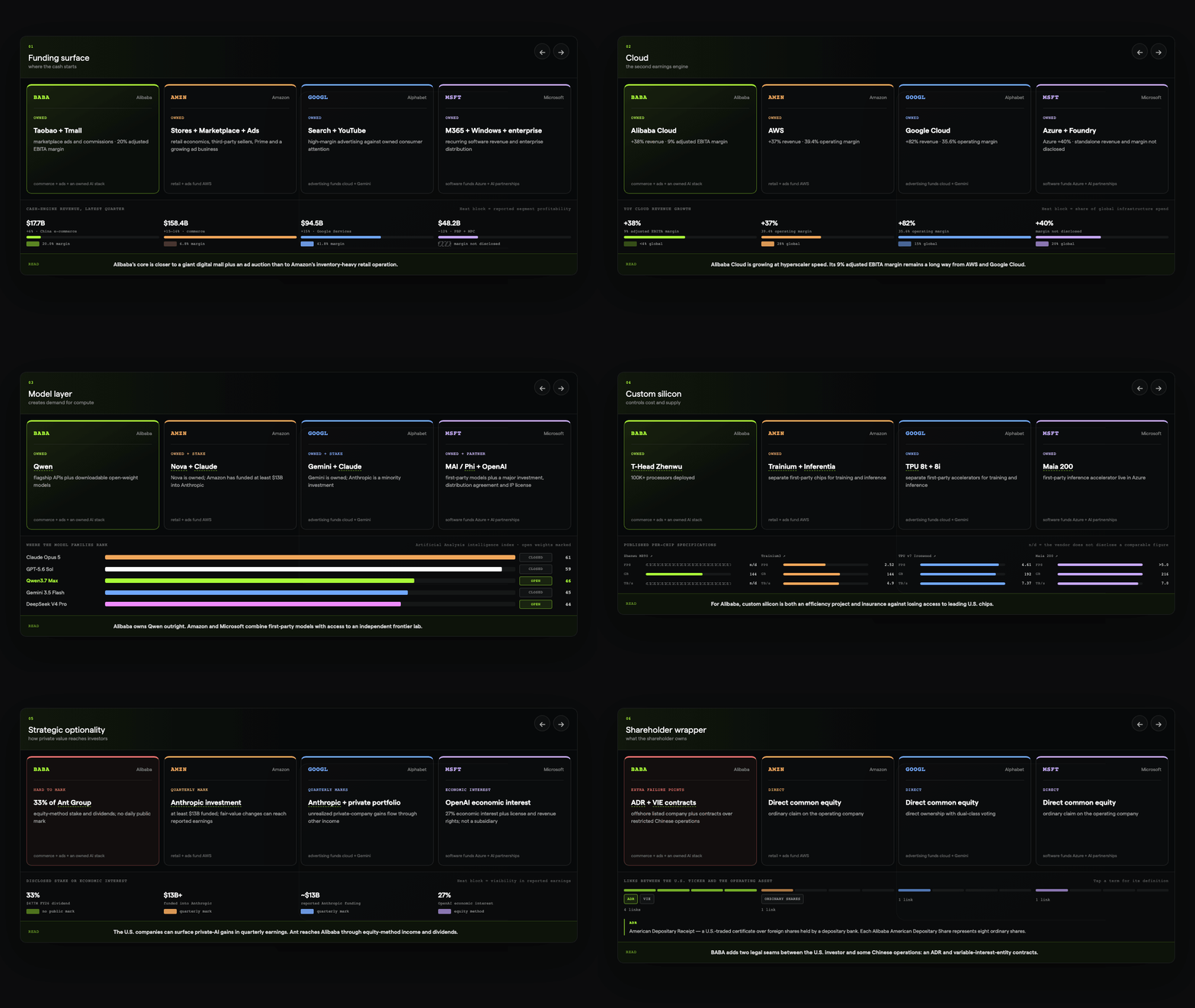
With the Alibaba pieces defined, the comparison becomes easier to read. Amazon, Alphabet, Microsoft, and Alibaba each combine a cash-generating distribution surface, public cloud, first-party models, and custom silicon. The ownership and economics differ at every layer.
Alibaba against the U.S. hyperscalers
Custom silicon
controls cost and supply
100K+ processors deployed
commerce + ads + an owned AI stackseparate first-party chips for training and inference
retail + ads fund AWSseparate first-party accelerators for training and inference
advertising funds cloud + Geminifirst-party inference accelerator live in Azure
software funds Azure + AI partnershipsAmazon owns Nova and Trainium, and it is a minority investor in Anthropic. Alphabet owns Gemini and Tensor Processing Units, and it also holds a minority Anthropic stake. Microsoft owns Azure, Phi, MAI, and Maia 200. Its OpenAI relationship includes an economic interest, licensing, and revenue rights; OpenAI is not a Microsoft subsidiary.
Alibaba's architecture belongs in the comparison. Its scale, margins, governance, and shareholder claim do not.
Why the discount is justified
China's technology crackdown changed the rules on Ant and the marketplace. Weak domestic demand hit merchants and ad budgets. U.S. chip controls limited the hardware Alibaba could buy. The variable interest entity structure adds contractual risk between some Chinese operations and foreign holders. All four sit between Alibaba's products and a U.S. investor's claim on them.
Four risks between the assets and the ADR
Ant IPO cancellation and Alibaba antitrust fine
Weak consumption and a shrinking population
Advanced chips require shifting U.S. licenses
ADR holders rely partly on contractual control
Regulation. Ant Group was days from a record IPO when the Shanghai Stock Exchange suspended it. The overhaul ended with RMB7.123B ($984M) in penalties and a much smaller private valuation. Alibaba still owns 33% and received a $477M Ant dividend in fiscal 2026, but Ant is separately governed and privately marked.
Demand. China's population fell by 3.39M in 2025, with 23% of the population age 60 or older. Retail sales grew only 2.7% in the first half of 2026. That slows the merchant and advertising engine just as Alibaba spends on quick commerce and AI.
Chips. Access to advanced processors turns on U.S. licensing policy. T-Head can replace some foreign accelerators, but fabrication, memory, and semiconductor equipment still cross the trade-policy boundary.
Ownership. A BABA American Depositary Receipt represents shares in Alibaba's Cayman holding company. For businesses held through variable interest entities, the group relies on contracts rather than direct equity ownership. Alibaba's annual filing also notes that the significant majority of its revenue, profit, and operating cash flow sits in directly owned subsidiaries. Not every dollar crosses the contractual seam.
Estimating fair market value without China Risk?
There is no neutral “American-company multiple.” Two May 2026 sum-of-the-parts reports offer a live range of assumptions: BOCI put BABA at $187 per American Depositary Share; DBS used $204. Those targets imply roughly 50% and 64% upside from the August 17 close, respectively. Put another way, BABA traded at 33% and 39% discounts to the two targets. Each estimate depended on forward assumptions for commerce and Cloud.
Reverse the current price instead. BABA closed at $124.71 on August 17 for a market value near $301.4B. Alibaba had about $37.8B of net cash. Fiscal 2026 China commerce adjusted EBITA was $15.586B. The slider below shows what remains after changing the multiple on that profit stream.
What does the stock leave for Cloud?
At 14× commerce, the residual is $45.4B. Mark Alibaba's 33% of Ant at the company's last disclosed 2023 transaction valuation and roughly $19.5B remains for Cloud, international commerce, logistics, Qwen, T-Head, and the losses elsewhere. Move commerce to 10× and the residual expands to $107.8B. The cheap reading depends on the multiple; now the dependency is visible.
That is the stock half of the thesis: Alibaba can deserve a China discount without Cloud, Qwen, and T-Head being worth almost nothing.
The options market asks a stranger question
Alibaba reports June-quarter results before the U.S. market opens on August 20. The August 21 options should be expensive, and they are: at-the-money implied volatility was 80.8% in Cboe's delayed chain on August 17, against about 30% for Amazon and Alphabet.
Earnings is expensive. The long end is not.
The chart opens on forward volatility, which strips out variance already packed into the earlier expiry. The August 21-28 window is 39.4%. The next two are 37.7% and 39.9%. Click Headline IV to put the 80.8% earnings spike back on the chart.
The odd price is at the other end. The December-to-June forward is 44.7%. BABA realized 44.4% over the past year. A seller of variance across next winter and spring gets almost no premium over what the stock just delivered.
Amazon and Alphabet pay one. Their corresponding forwards are 36.3% and 35.7%, against realized volatility of 33.8% and 32.4%.
BABA pays almost nothing over realized
Four days of fear, ten months at cost
The curve is quiet around other scheduled shocks too. The August 21-28 forward, which contains NVIDIA's August 26 results, is 39.4%. The next window, which contains China's August 31 PMI release, is 37.7%. Neither event commands much extra premium.
The curve charges a lot for four days and almost nothing extra for ten months. Export controls, variable-interest-entity governance, consumption, and domestic competition will not resolve on August 20. Neither will Cloud margin, paid AI demand, or T-Head utilization.
The mismatch
At 30% annual growth and a 20% adjusted EBITA margin, Cloud would earn quarterly profit equal to 76% of today's China-commerce profit. At a 14× commerce multiple, the stock leaves $45.4B for everything else before separately marking Ant. The December-to-June forward trades at 44.7% against 44.4% realized.
What would prove this wrong
The August 20 report will move the inputs. It cannot settle a three-year cloud buildout, but it can make the cheap reading look better or worse.
Five numbers that change the valuation
Cloud has to keep outgrowing commerce. AI revenue has to come from paying companies, not consumer-app downloads. Margin has to leave single digits without quick-commerce losses swallowing the improvement. T-Head has to prove useful beyond Alibaba's own infrastructure. Some of the value inside Ant and the rest of the structure has to reach the American Depositary Receipt holder.
If Cloud slows back toward commerce growth, margin stays near 9%, and the rest of the portfolio keeps consuming the core's profit, the commerce classification survives. If growth holds and margin moves into the high teens, the earnings mix changes with it.
The stock prices Alibaba as Chinese e-commerce. The long-dated options barely price the chance that the market changes its mind, in either direction.